 English

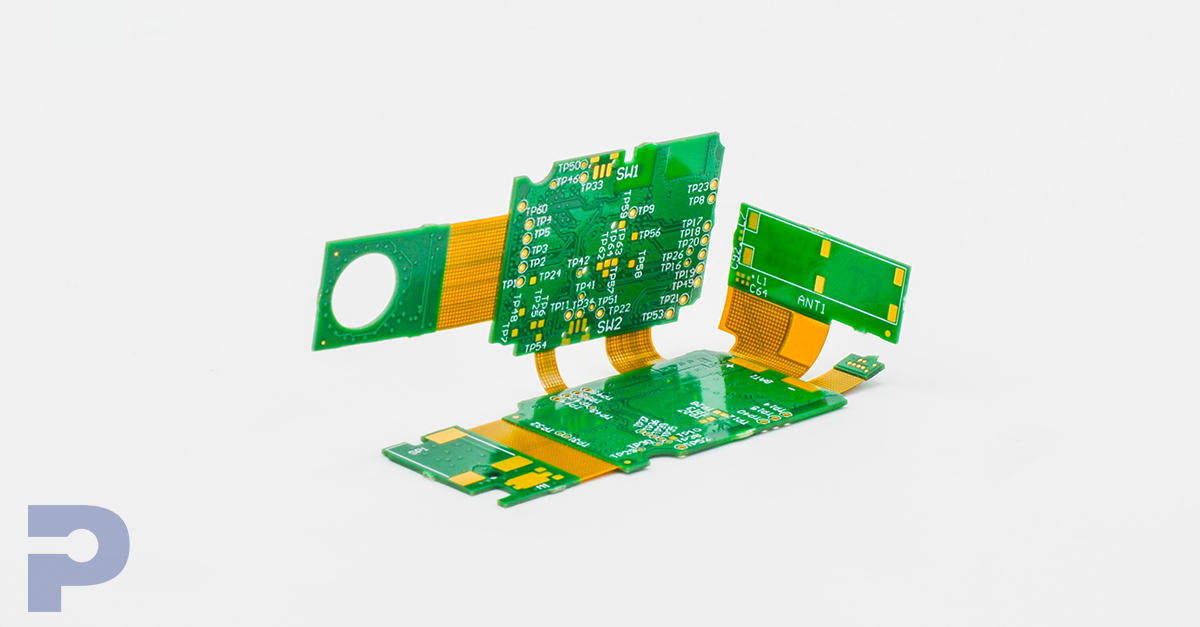
Core and prepreg materials both provide dielectric insulation within a printed circuit board, but they serve different roles. A core is a fully cured laminate that provides a stable base for copper circuitry. Prepreg is a partially cured resin system that flows during lamination, bonding PCB layers together and filling spaces around etched copper features. The distinction is straightforward in rigid boards, but flex and rigid-flex constructions use related materials under different names, including flexible laminate, bondply, adhesive film, and no-flow prepreg.
What Is a PCB Core?
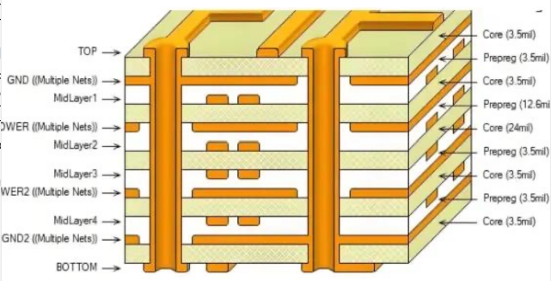
A PCB core is a fully cured dielectric laminate, commonly described as C-stage material. In a conventional rigid PCB, it typically consists of woven fiberglass impregnated with cured epoxy resin and copper foil bonded to one or both sides. The copper is imaged and etched to create circuitry before the core is laminated with additional layers.
Because the resin is already cured, a core has minimal flow during final lamination. This provides relatively stable dielectric spacing, dimensional support, and predictable thickness.
Common rigid PCB core materials include:
• Standard and high-temperature FR-4
• Low-loss and high-speed digital laminates
• RF and microwave laminates
• Polyimide-based rigid laminates
• Thermally conductive and metal-clad laminates
What Is PCB Prepreg?
Prepreg is usually woven glass fabric impregnated with partially cured resin. During multilayer lamination, heat and pressure cause the resin to soften and flow. It fills spaces around copper traces, bonds adjacent layers, and then cures into a solid dielectric.
Prepreg therefore performs three connected functions: bonding the stackup, electrically insulating conductive layers, and encapsulating etched copper features. Its final thickness depends on glass style, resin content, copper density, and lamination conditions, so it is generally less fixed than core thickness.
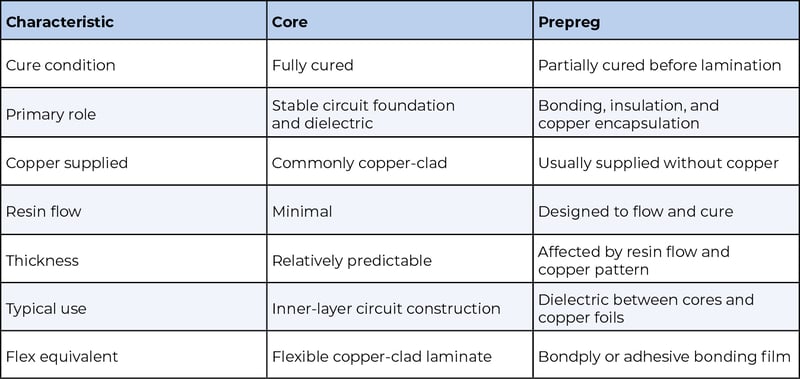
Core vs. Prepreg at a Glance
Build a better PCB from the inside out.
Explore PICA’s PCB manufacturing capabilities for support with material selection, stackup design, and reliable production.
How Core and Prepreg Are Used in Rigid PCBs
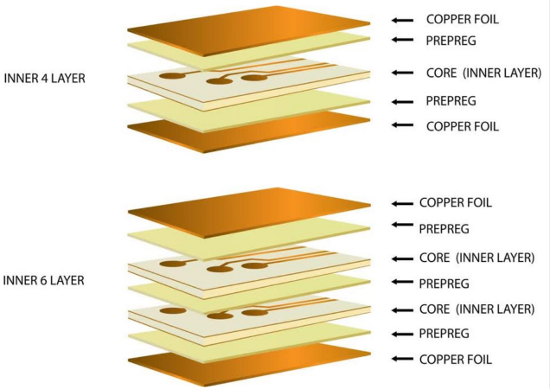
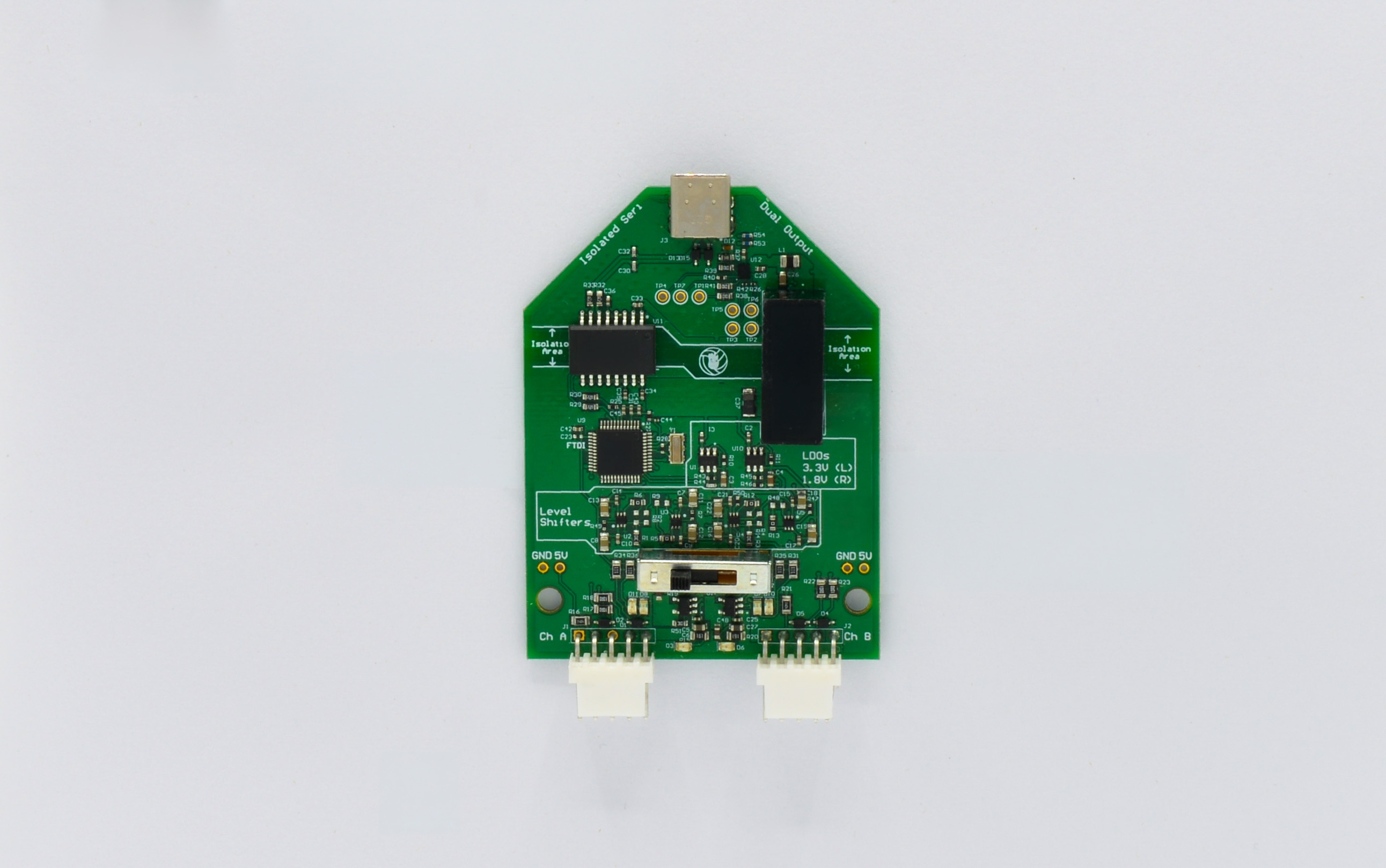
A double-sided rigid PCB can be made from one copper-clad core. In multilayer boards, etched cores are separated by prepreg and combined with outer copper foil. During lamination, the prepreg flows around the circuitry and bonds the construction into one structure.
A simplified six-layer construction may include:
• Outer copper foil
• Prepreg
• Copper-clad core
• Prepreg
• Copper-clad core
• Prepreg
• Outer copper foil
The fabricator balances core and prepreg thicknesses to meet overall board thickness, impedance, copper weight, thermal, reliability, and manufacturing requirements.
How the Terminology Changes in Flex PCBs
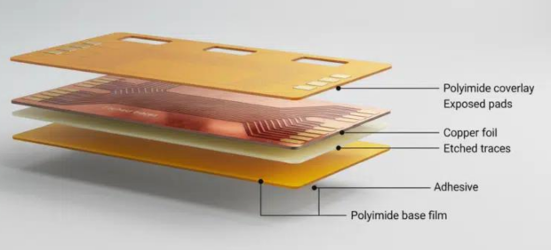
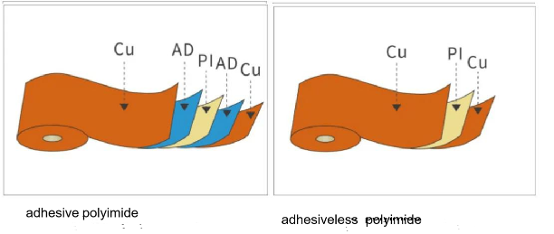
Flexible circuits generally use flexible copper-clad laminate instead of conventional FR-4 core. This material usually combines copper foil with a polyimide dielectric and may be adhesiveless or adhesive-based. Functionally, it serves as the flexible circuit's cured base material.
Traditional woven-glass prepreg is normally too rigid for areas intended to bend. Multilayer flex circuits instead use flexible bonding materials such as polyimide bondply, acrylic or epoxy adhesive films, unsupported sheet adhesives, and coverlay adhesive. These products perform a bonding function similar to prepreg while preserving flexibility after cure.
Core and Prepreg in Rigid-Flex PCBs
Rigid-flex designs combine flexible laminates with rigid cores and bonding materials. Flexible copper-clad polyimide typically runs continuously through the flex regions, while rigid cores, copper foil, and prepreg build the component-support sections.
Standard prepreg may flow into flex openings during lamination. For that reason, rigid-flex constructions often use low-flow or no-flow prepreg in selected areas. The correct material and press cycle depend on opening geometry, copper distribution, resin requirements, and the fabricator's process.

Electrical Performance Considerations
Core and prepreg from the same material family may not produce identical electrical behavior. Effective dielectric constant and loss are influenced by resin content, glass weave, finished thickness, copper roughness, frequency, and local trace position.
Controlled-impedance and high-speed stackups should therefore be modeled using the fabricator's expected finished dielectric thicknesses and appropriate design values. Changing prepreg style or replacing multiple thin plies with one thicker ply can alter resin distribution, glass structure, registration, and electrical performance even when the nominal total thickness appears similar.
Mechanical and Reliability Considerations
Copper weight and circuit density: Heavy copper and widely spaced features require enough resin to fill the spaces between conductors. An unsuitable prepreg may lead to voids or resin-starved areas.
Overall thickness: Core thickness is generally more stable, while the finished contribution of prepreg depends partly on copper pattern and resin flow.
Thermal reliability: The dielectric system must withstand assembly heat and thermal cycling without excessive Z-axis expansion, delamination, or stress on plated through holes.
Dimensional stability: Thin cores, flexible laminates, and unbalanced copper can make registration more difficult. Stackup symmetry and material reinforcement should be reviewed together.
Bend performance: Glass-reinforced prepreg should not extend into an active flex zone. Bend areas require flexible dielectrics, suitable copper, and a controlled bend radius.
Cost and Sourcing Considerations
Standard core and prepreg combinations are usually easier to source than uncommon thicknesses or specialty systems. However, the lowest material price does not always produce the lowest total cost if a construction requires special handling, extra lamination cycles, or nonstandard procurement.
Sourcing teams should confirm:
• Compatibility between the core and prepreg resin systems
• Availability of specified glass styles and thicknesses
• Minimum order quantities and shelf-life requirements
• Regional stock and lead times for specialty materials
• Approved equivalent materials and substitution rules
• Whether changes require impedance or reliability requalification
Can Core and Prepreg Be Substituted?
Core and prepreg are complementary, not interchangeable. A cured core cannot provide the bonding and gap-filling function of prepreg, while prepreg does not provide the same pre-lamination stability or fixed thickness as a core.
A fabricator may adjust the balance of core and prepreg within a stackup, but the change should be reviewed for impedance, overall thickness, resin fill, registration, via reliability, flexibility, and material availability. Substitutions are especially sensitive in high-speed, RF, high-voltage, medical, aerospace, and rigid-flex applications.
Questions to Ask When Reviewing a Stackup
1. Which layers are built on cured cores or flexible laminates?
2. Which materials bond the layers together?
3. What are the expected finished dielectric thicknesses?
4. Is there enough resin for the copper weight and circuit pattern?
5. Are the core and prepreg materials compatible?
6. What dielectric values are being used for impedance modeling?
7. Does any glass-reinforced material enter an active flex zone?
8. Is low-flow or no-flow prepreg required?
9. Are the specified materials routinely stocked?
10. What substitutions are approved if availability changes?
Choosing the Right Material Construction
In rigid PCBs, cores provide stable circuit layers while prepreg bonds those layers and establishes dielectric separation. In flex circuits, flexible copper-clad laminate serves as the circuit foundation, while bondply and adhesive films provide flexible interlayer bonding. Rigid-flex designs combine both material families and require tighter control of resin flow, thickness, and bend-zone construction.
The right stackup must balance electrical performance, mechanical reliability, manufacturing capability, availability, and total program cost. Early review with the PCB fabricator can help identify practical core, prepreg, laminate, and bonding-material combinations before the design is released.
Need help reviewing a rigid, flex, or rigid-flex stackup? Contact PICA Manufacturing Solutions to discuss material availability, construction options, and qualified alternatives for your application.
References
• IPC-4101, Specification for Base Materials for Rigid and Multilayer Printed Boards
• Isola, PCB Laminates and Prepreg
• Isola, P25N Polyimide-Based No-Flow Prepreg Processing Guide
• DuPont, Flexible Circuit Materials and Pyralux AP
• Isola, IS420 Core and Prepreg Dk/Df Data
• Rogers Corporation, RO4000 Series Laminates