 English

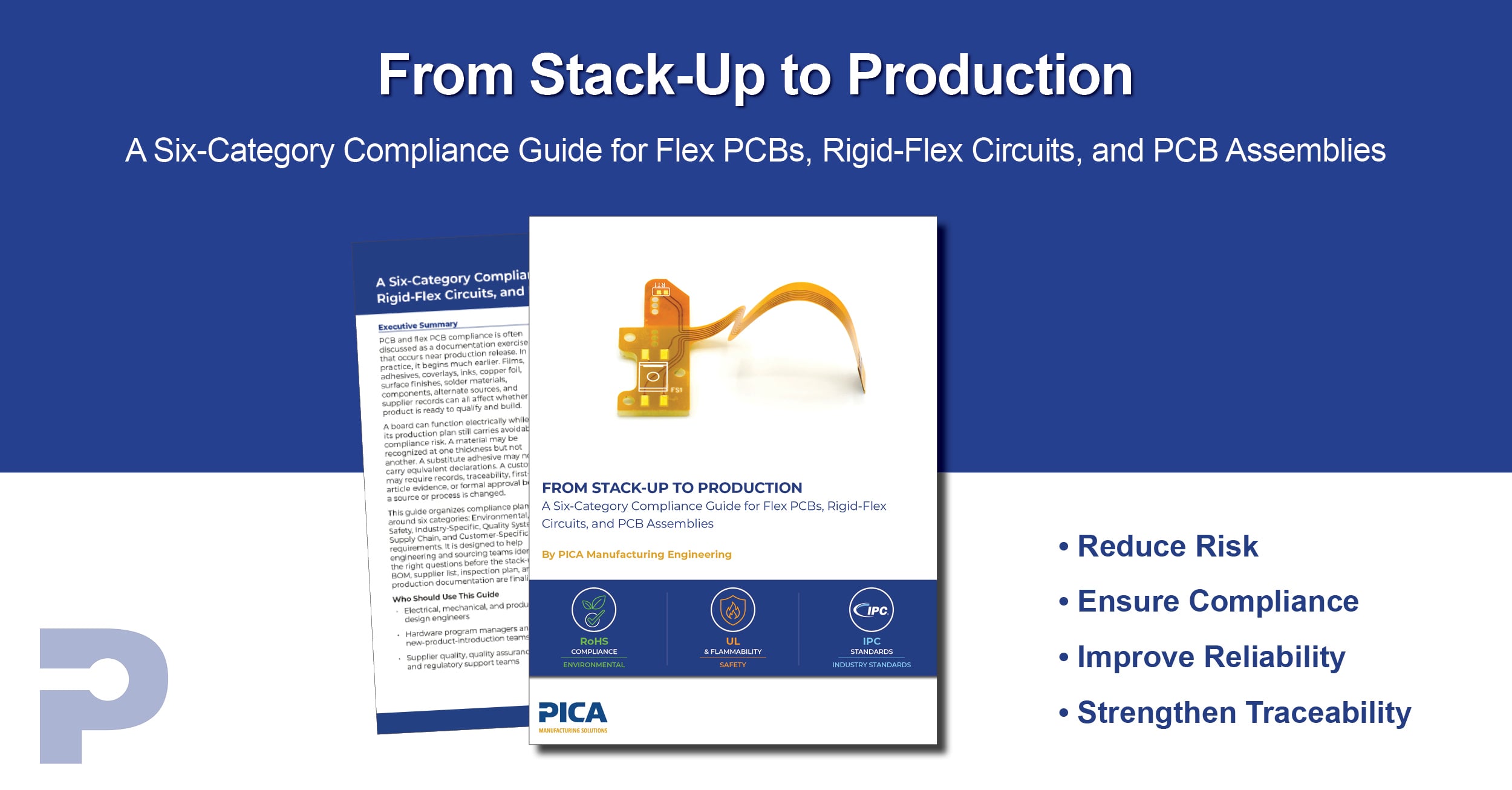
A new PICA Manufacturing Solutions eBook gives engineering, sourcing, and quality teams a practical framework for planning compliance before materials and production processes are locked.
Compliance Begins Before Production Release
PCB compliance is often addressed as production release approaches. For flex PCBs, rigid-flex circuits, and electronic assemblies, that timing can expose a program to avoidable risk. A board may function electrically while the production plan still depends on an adhesive with incomplete declarations, a film recognized at a different thickness, an undocumented alternate source, or a customer approval that was never included in the schedule.
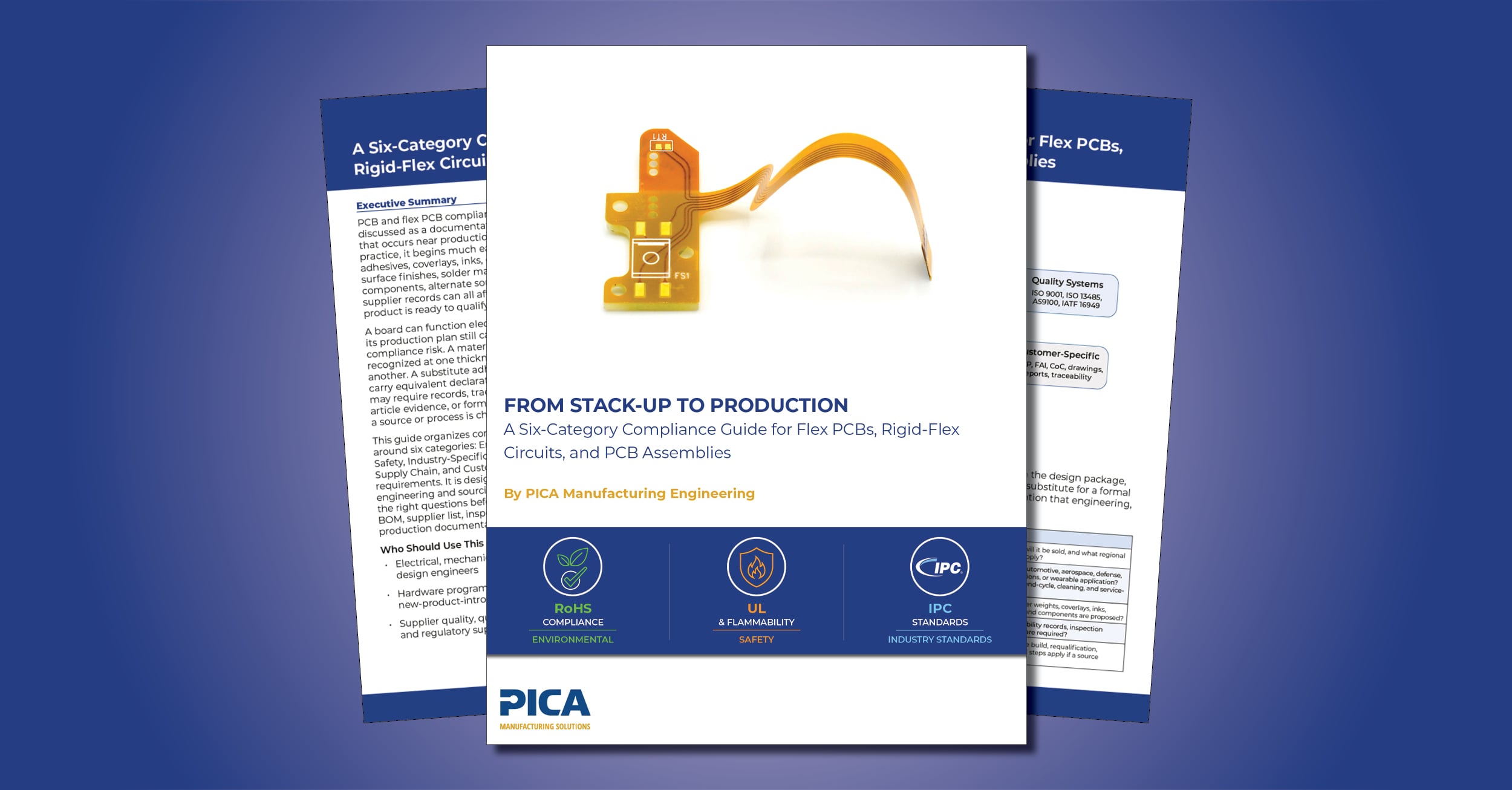
PICA Manufacturing Solutions' eBook, From Stack-Up to Production: A Six-Category Compliance Guide for Flex PCBs, Rigid-Flex Circuits, and PCB Assemblies, shows teams how to identify these issues earlier. It connects compliance planning to the decisions that shape the stack-up, bill of materials, supplier list, inspection plan, and production documentation.
The Actual Construction Matters
Flex and rigid-flex circuits combine thin, application-specific materials. Copper foil, polyimide, adhesives, coverlays, inks, stiffeners, solder systems, plating, and surface finishes must be evaluated as an actual construction. A familiar material family name alone does not establish that the required environmental declarations, safety evidence, or customer approvals apply to the grade and thickness being used.
The eBook recommends developing a brief compliance profile at project kickoff. This profile captures the intended market, end-use environment, application risks, proposed materials, required records, and rules for managing changes. It can then travel with the design package, quote request, BOM, drawings, and supplier review so that each function works from the same requirements.
Six Categories Organize the Review
Requirements vary by product, market, customer, and manufacturing pathway. The eBook organizes the review into six categories: Environmental, Safety, Industry-Specific, Quality Systems, Supply Chain, and Customer-Specific requirements.
Environmental planning may include RoHS, REACH and SVHC review, California Proposition 65, halogen-free documentation, PFAS inquiries, and customer substance lists. Safety review may involve UL-related or flammability evidence that applies to the actual construction. Industry-specific planning helps teams define the correct IPC standards, revision levels, classes, and additional expectations for medical, aerospace, defense, automotive, industrial, communications, consumer, or wearable products.
The framework also covers quality-system expectations such as ISO 9001, ISO 13485, AS9100, IATF 16949, and ISO 14001. Supply-chain review addresses areas such as CMRT and 3TG reporting, country of origin, approved sources, supplier records, and obsolescence. Customer-specific planning captures PPAP, first-article inspection, certificates of conformance, test records, traceability, packaging, labeling, record retention, and formal change approvals.
FROM STACK-UP TO PRODUCTION
A Six-Category Compliance Guide for Flex PCBs, Rigid-Flex Circuits, and PCB Assemblies
Changes After Release Need Control
Compliance work continues after production begins. A supplier may reformulate an adhesive, a component may become obsolete, or an alternate material may be proposed to improve cost or lead time. Any of these changes could affect bend performance, thermal behavior, flammability support, environmental declarations, inspection criteria, or qualification status.
The eBook provides questions teams can use to decide whether a proposed change requires a document update, customer notification, sample build, requalification, PPAP submission, first-article inspection, or written approval. This discipline helps preserve the approved construction and prevents an apparently minor substitution from disrupting production or customer acceptance.
A Practical Path from Concept to Ongoing Production
PICA maps compliance planning across five program gates: concept, stack-up and sourcing, prototype, production release, and ongoing production. Teams first identify the market, application, risk, and customer requirements. They then confirm exact materials, thicknesses, finishes, suppliers, declarations, inspections, tests, and documentation before release. Once production begins, they maintain supplier records, manage product change notifications, and monitor requalification triggers.
The eBook also includes a practical pre-production checklist that teams can use during design reviews, quoting, supplier qualification, prototype builds, and production release. It is written for engineers, hardware program managers, new-product-introduction teams, quality and regulatory professionals, and sourcing specialists working across demanding electronics applications.
Download the eBook
Download From Stack-Up to Production to bring compliance questions into the development process while teams still have options. For help connecting design intent, material selection, supplier coordination, documentation, and production readiness, contact PICA Manufacturing Solutions at engineering@picamfg.com or (855) 742-2634.