 English

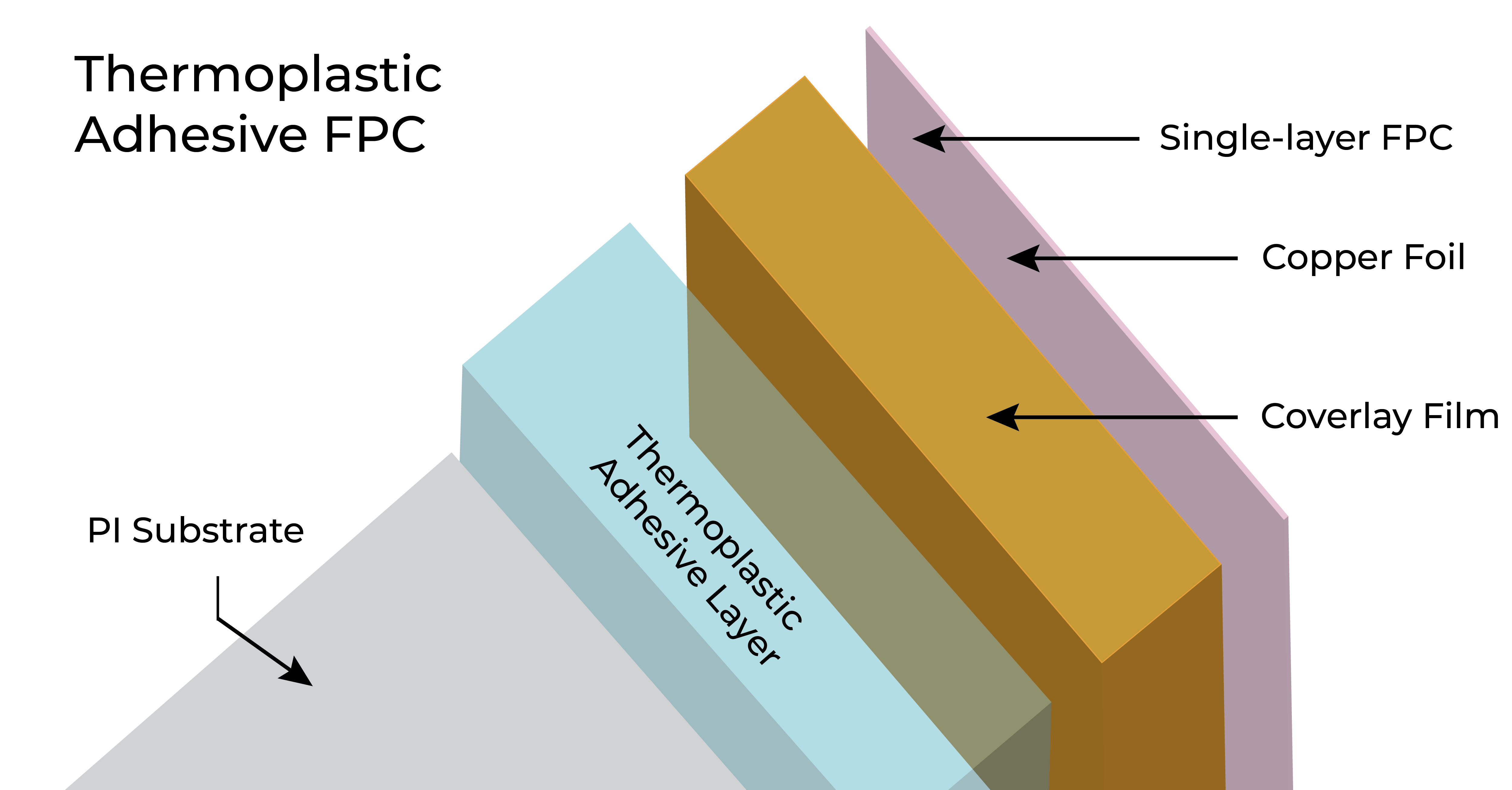
Thermoplastic vs thermoset adhesives, adhesiveless constructions, and the process factors that drive delamination risk
In flex circuits, reliability is not determined by copper and substrate alone. A large share of real-world failures trace back to the bond line. Bond systems influence peel strength, bend durability, thermal survivability through reflow, moisture stability, and long-term interface integrity.
This guide focuses on three practical areas engineers need when selecting or reviewing flex constructions:
1. Thermoplastic vs thermoset adhesive behavior
2. Adhesiveless constructions and why they can improve bend life
3. Bonding/lamination considerations and common failure modes tied to process and design details
1) Thermoplastic vs Thermoset Adhesives
Flow behavior, reworkability, reliability, and typical applications
In flex manufacturing, “adhesive” usually refers to bonding layers used to:
• Attach copper to a polymer /PET film
• Bond layers together in multilayer flex
• Support coverlay/stiffener bonding or interface regions (depending on construction)
Even when two adhesives achieve similar initial peel strength, they can behave very differently after repeated bending, multiple reflows, humidity exposure, or thermal cycling.
Thermoplastic adhesives
Core behavior: soften when heated and re-solidify when cooled, repeatable melting and solidification.
Common materials: Polyester (PET), polyolefins, thermoplastic polyimide (TPI).
What this means in practice
Flow
• Thermoplastics can soften and flow under heat, which can help wet-out and interface contact during bonding.
• Because they soften again at elevated temperatures, design and process control matter to prevent movement or creep in high-temperature service.
Reworkability
• In many cases, thermoplastic systems are more rework-friendly because heat can soften the material again (subject to construction and geometry)
• Reworkability can be an advantage, but it does not automatically mean better long-term stability.
Reliability considerations
• If the circuit experiences elevated temperatures in service, repeated reflow, or thermal cycling, thermoplastic softening behavior can become a risk driver if the system is near its limits.
• Long-term interface stability depends on temperature margins, stress concentrations, and moisture behavior.
Typical application patterns
• Often considered when moderate thermal exposure is expected and bonding flow or rework practicality is beneficial.
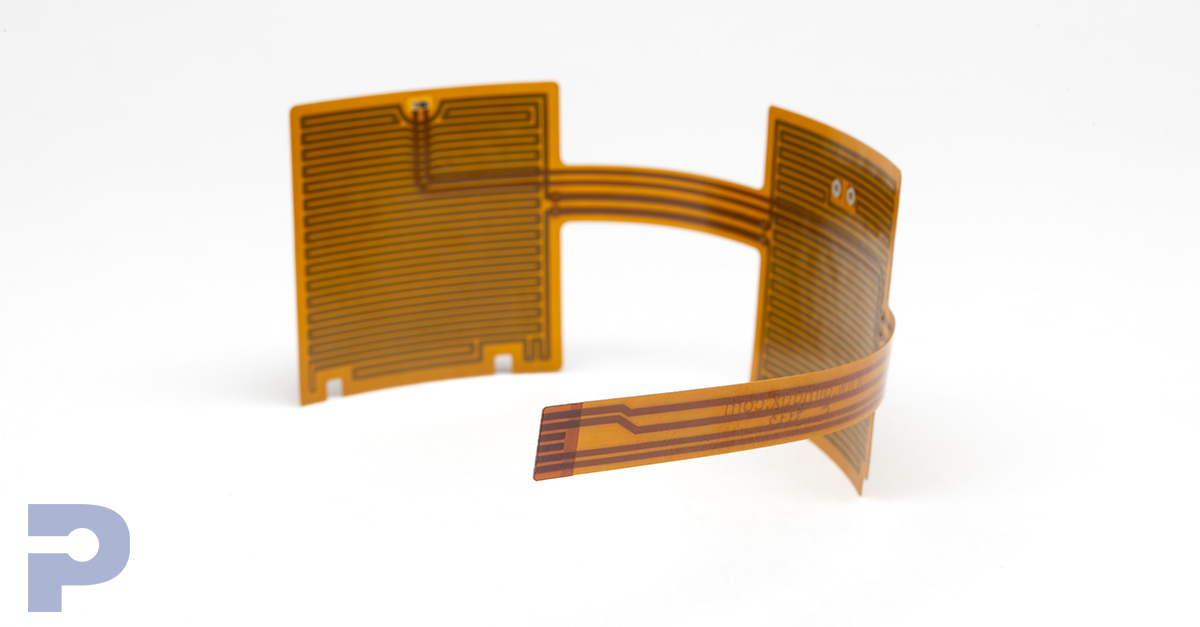
• Consumer electronics-Bluetooth sensor cables, small bracelet internal flexible cables, low-stress static bending printer sensor
• Prototyping and low-volume production: R&D samples requiring frequent repair or adjustment.
Thermoset adhesives
Core behavior: cure (crosslink) into a stable network and do not re-melt after cure.
Common materials: Epoxy systems, acrylics, thermoset polyimide adhesive.
What this means in practice
Flow
• Thermosets are formulated to flow during lamination, then cure and “lock in” the interface, will not re-melt or dissolve after curing.
• Once cured, they typically resist re-softening at temperatures that would soften a thermoplastic.
Reworkability
• Usually less reworkable after cure because the crosslinked structure does not re-melt.
• Disassembly and rework can become destructive depending on the design.
Reliability considerations
• Thermosets are often favored when post-lamination stability through reflow and thermal cycling is a priority.
• Long-term behavior can still be impacted by moisture exposure, interface preparation, voiding, and CTE mismatch.
• Adaptation to lead-free reflow soldering and automotive-grade temperature cycling
Typical application patterns
• Common in applications that need stable bonding through repeated thermal excursions and environments where interface movement would be unacceptable. Automotive electronics headlight control FPC, power battery sensing boards, high-frequency/high-speed flex circuits, high-reliability consumer electronics.
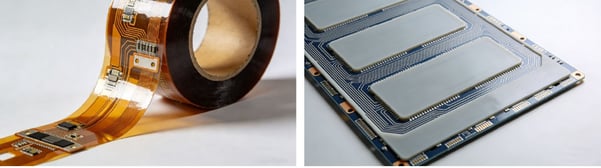
Need help selecting the right adhesive system for your flex design?
Talk with PICA’s engineering team about thermoplastic vs. thermoset options, adhesiveless constructions, and bond-line reliability before issues become redesigns.
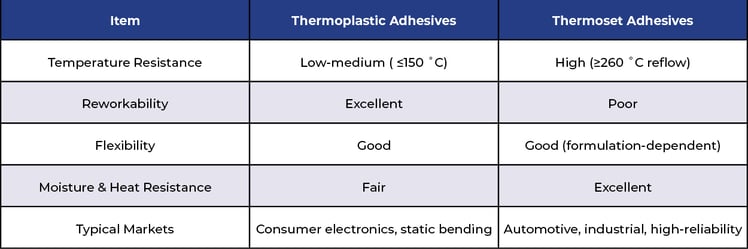
Practical comparison (quick selection logic)
Use the simplest filter first:
• If stability through reflow and cycling is the dominant concern, thermoset behavior often aligns with that need.
• If bonding flow and potential rework practicality are valuable and thermal exposure is controlled, thermoplastic behavior may be a fit.
Selection still depends on the full construction. The “best adhesive” cannot compensate for poor strain control in the bend zone or weak surface preparation.
2) Adhesiveless Constructions
How they are made, why bend life can improve, and the cost/availability tradeoffs
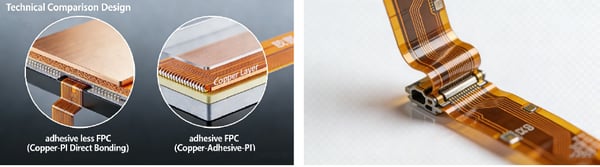
Adhesiveless constructions are frequently evaluated for dynamic flex or tight-radius designs because they reduce or eliminate a bonding layer that can become a mechanical weak point during repeated bending.
What “adhesiveless” means in flex
In an adhesiveless construction, copper is attached to the base film without a separate adhesive layer between copper and film. This can reduce overall thickness and remove one interface where fatigue and delamination can initiate.
How adhesiveless constructions are made (high level)
Manufacturing approaches vary by material system and supplier, but the common goal is to achieve copper-to-film attachment without the traditional adhesive layer. The result is often a thinner, more mechanically consistent core.
Why adhesiveless can improve bend life
Adhesive layers can introduce:
• A different mechanical response than copper and film
• A potential site for micro-cracking under repeated strain
• An interface that may weaken under heat and humidity depending on the system
By removing that layer, adhesiveless constructions can:
• Reduce strain concentration at the interface
• Higher consistency of materials,improve fatigue resistance 3-10X in dynamic bend regions
• Reduce thickness and stiffness in the bend zone, depending on the stack-up
• Superior high-frequency electrical properties
Tradeoffs to expect
Adhesiveless is not automatically the right answer. Common tradeoffs include:
• Higher cost compared with standard adhesive-based constructions
• Availability and lead-time constraints depending on material family and supplier base
• DFM limits that may differ from “standard” flex stack-ups
• Fewer simple alternate material substitutions if supply becomes constrained
Practical checkpoint: adhesiveless is most defensible when the requirements clearly demand higher bend life or tighter mechanical margins.
3) Bonding and Lamination Considerations
Process variables and failure modes that dominate real-world reliability
A well-chosen adhesive system can still fail if lamination is not controlled or the design creates stress concentrators. Bonding performance is a combination of material choice + surface prep + lamination profile + stack geometry.
Process factors that influence bond quality
Surface preparation and cleanliness
• Contamination and inadequate surface prep reduce adhesion and can create early delamination or peel failures.
Pressure, temperature, and dwell profile
• Too little can prevent wet-out and create voids.
• Too much can drive squeeze-out, thickness variation, or distortion.
Moisture control
• Some materials are sensitive to moisture during storage and processing. Moisture can increase voiding risk and interface weakness.
Stack symmetry and mismatch
• CTE mismatch and asymmetric stack-ups can lead to warpage, curling, and interface stress during thermal excursions.
Transition design and local thickness changes
• Stiffener edges, openings, and abrupt thickness transitions drive local strain and can trigger peel or delamination.
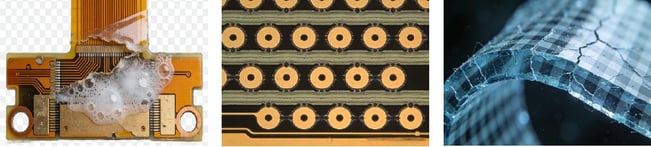
Common failure modes tied to bonding
Delamination
• Often driven by thermal cycling, reflow exposure, humidity, or weak interfacial adhesion.
Voids
• Reduce interface integrity and can localize stress, contributing to peel and delamination propagation.
Adhesive squeeze-out or movement
• Can alter local thickness, affect coverlay openings, or create stiffness changes that shift strain into vulnerable areas.
Peel failures at interfaces
• Common near connector zones, exposed copper edges, stiffener boundaries, and areas that see repeated handling.
Cracking at transitions
• Often caused by strain concentration at openings and thickness steps, especially when bend regions are too close to interfaces.
Choose the Right Flex PCB Adhesive System with PICA's Support
In flex, bond systems are structural. They influence bend life, thermal survivability, and long-term reliability through environmental exposure. A dedicated comparison between thermoplastic and thermoset behavior, plus a clear understanding of adhesiveless constructions, helps prevent delamination-driven failures and reduces late-stage redesign risk.