 English

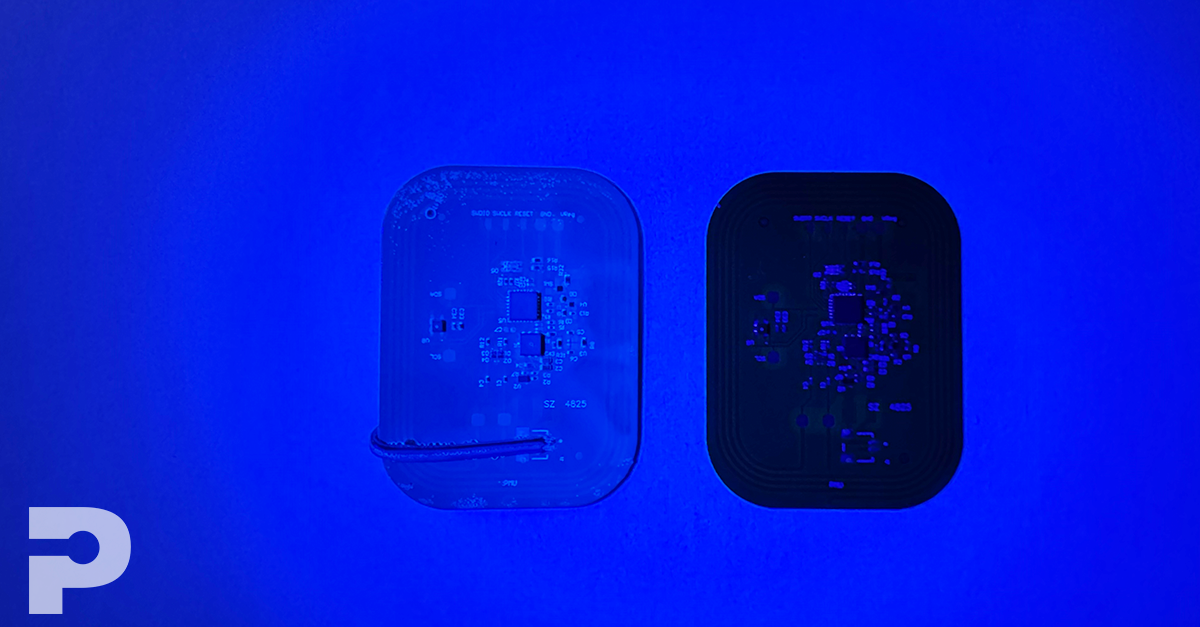
Printed circuit board assemblies are used in products that need to perform reliably in demanding environments. From medical devices and industrial controls to wearables and automotive electronics, both rigid and flexible PCB assemblies may be exposed to moisture, dust, chemicals, temperature changes, and other conditions that can affect long-term reliability.
Conformal coating is one way to add a protective barrier to PCB assemblies. When properly selected and applied, it can help protect sensitive circuitry from environmental contaminants while allowing the assembly to remain relatively lightweight and accessible.
What Is Conformal Coating?
Conformal coating is a thin polymer film applied over selected areas of an assembled printed circuit board and its components. The coating follows the contours of the board, components, and solder joints, helping protect vulnerable surfaces without fully encapsulating the assembly.
Unlike potting compounds, which typically surround or fill an electronic assembly with a much thicker material, conformal coatings provide a thin protective layer. Certain areas, including connector contacts, test points, and other functional surfaces, may need to remain uncoated.
Why Conformal Coating Matters for PCB Assemblies
Both rigid and flexible PCB assemblies can encounter environmental conditions that affect electrical performance and service life. Even electronics installed inside an enclosure may experience humidity, condensation, dust, chemical contaminants, or residues.
A properly selected conformal coating can help reduce direct exposure of conductors, solder joints, and other sensitive surfaces to these conditions. This can be particularly important for compact, high-density, or high-reliability electronics used in demanding applications.
The need for conformal coating depends on the application's operating environment, enclosure, assembly materials, reliability requirements, and expected service life rather than whether the circuit is rigid or flexible.
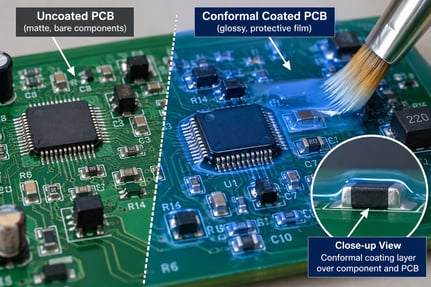
What Conformal Coating Helps Protect Against
Moisture and Corrosion
Moisture combined with salts, residues, or other contaminants can contribute to corrosion of exposed conductors and solder joints. Over time, corrosion can affect electrical performance and potentially lead to assembly failure.
Conformal coating provides a barrier that helps limit contact between sensitive electrical surfaces and environmental moisture or contamination. However, coating does not make an assembly completely waterproof and cannot compensate for contamination already present on the board. Proper cleaning and surface preparation remain important parts of the coating process.
Leakage Currents and Contamination-Related Shorts
Moisture and ionic contamination can create unintended conductive paths between closely spaced electrical features. As electronic assemblies become smaller and component densities increase, controlling contamination becomes increasingly important.
Properly applied conformal coating can help reduce exposure to contaminants that contribute to leakage currents or short circuits. It should complement appropriate conductor spacing, assembly cleanliness, and sound PCB design practices rather than replace them.
Chemical and Environmental Exposure
Depending on the coating chemistry, conformal coatings can provide resistance to specific chemicals, solvents, fuel vapors, humidity, salt mist, and other environmental contaminants.
Coating selection should be based on the actual substances and conditions the assembly is expected to encounter. The selected material should also maintain its protective properties across the application's required operating temperature range.
Common Types of Conformal Coating
Several conformal coating chemistries are commonly used for electronic assemblies.
Acrylic coatings are often selected because they are relatively easy to apply and can simplify rework or repair.
Silicone coatings can provide flexibility and maintain performance across a wide range of operating temperatures, making them useful for applications involving thermal cycling or movement.
Urethane coatings can provide strong resistance to chemicals and environmental contaminants.
Parylene coatings are applied through a vapor-deposition process and can provide thin, highly uniform coverage, including around complex component geometries.
Some coating formulations also support UV curing, which can help reduce processing time in manufacturing. UV curing refers to the curing method rather than a separate coating chemistry, and component shadowing or secondary curing requirements should be considered when developing the process.
The appropriate coating depends on the operating environment, assembly materials, cure requirements, rework needs, desired coating thickness, and manufacturing process.
Looking for a reliable flex PCB partner?
See how PICA Manufacturing Solutions supports advanced flex PCB applications with engineering-driven design and manufacturing expertise.
Special Considerations for Flex PCB Assemblies
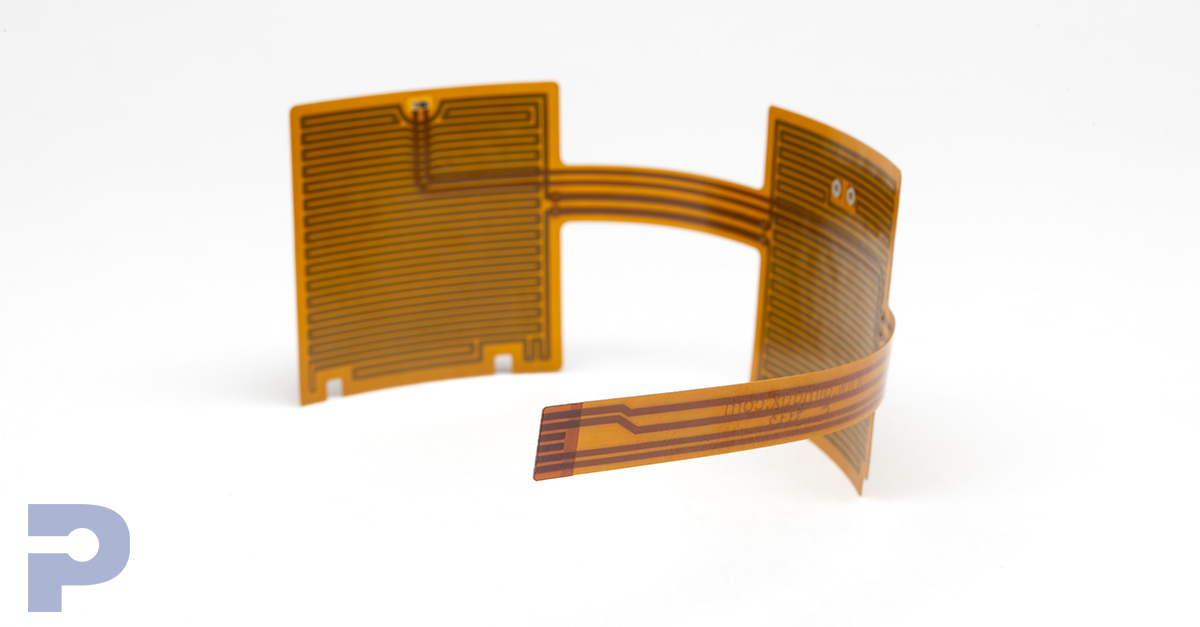
Flexible PCB assemblies introduce additional considerations because the circuit may bend, fold, twist, or move during installation or operation.
Some flex circuits are bent into position during assembly and remain stationary for the rest of their service life. Others are designed for repeated movement, such as circuits used across hinges or in other dynamic-flex applications. These two situations can place very different mechanical demands on a conformal coating.
A coating that performs well on a rigid PCB assembly may not necessarily be appropriate for a dynamic flex application. For flex circuits, engineers should consider coating flexibility, cured thickness, adhesion, bend radius, and the number of expected flex cycles.
The coating should not create excessive stiffness or crack and delaminate as the circuit moves. Areas intended to flex may require different coating strategies from areas containing components or remaining stationary.
For dynamic-flex applications, the coated assembly should be validated under representative operating conditions, including the intended bend radius and expected number of flex cycles.
Application Quality Matters
The performance of conformal coating depends on more than selecting the right material. Surface preparation, masking, application method, coverage, coating thickness, curing, and inspection all affect the finished assembly.
Areas that should remain uncoated need to be clearly defined before processing. These may include connectors, electrical contacts, test points, grounding locations, or other functional surfaces.
Manufacturers should also verify that the coating reaches the areas requiring protection, particularly around component leads and complex geometries, while maintaining access to areas needed for testing or future rework.
What Conformal Coating Does Not Replace
Conformal coating should be viewed as one part of an overall electronics reliability strategy.
It does not replace proper PCB design, adequate conductor spacing, good assembly practices, appropriate cleaning, or suitable enclosure protection. It also does not automatically make a PCB assembly waterproof or eliminate the effects of every environmental hazard.
Instead, conformal coating provides an additional protective barrier that can complement these other design and manufacturing practices.
Conclusion
Conformal coating can help improve the long-term reliability of both rigid and flexible PCB assemblies by providing additional protection against moisture, contamination, corrosion, and certain chemical exposures.
Selecting the appropriate coating requires understanding the assembly materials, manufacturing process, operating environment, and service requirements. For flex circuits, designers must also consider how the coating will respond to bending and movement throughout the life of the product.
When coating material, PCB design, application process, and operating conditions are considered together, conformal coating can become an important part of a reliable PCB assembly strategy.